


EU proposes strict social media limits for children
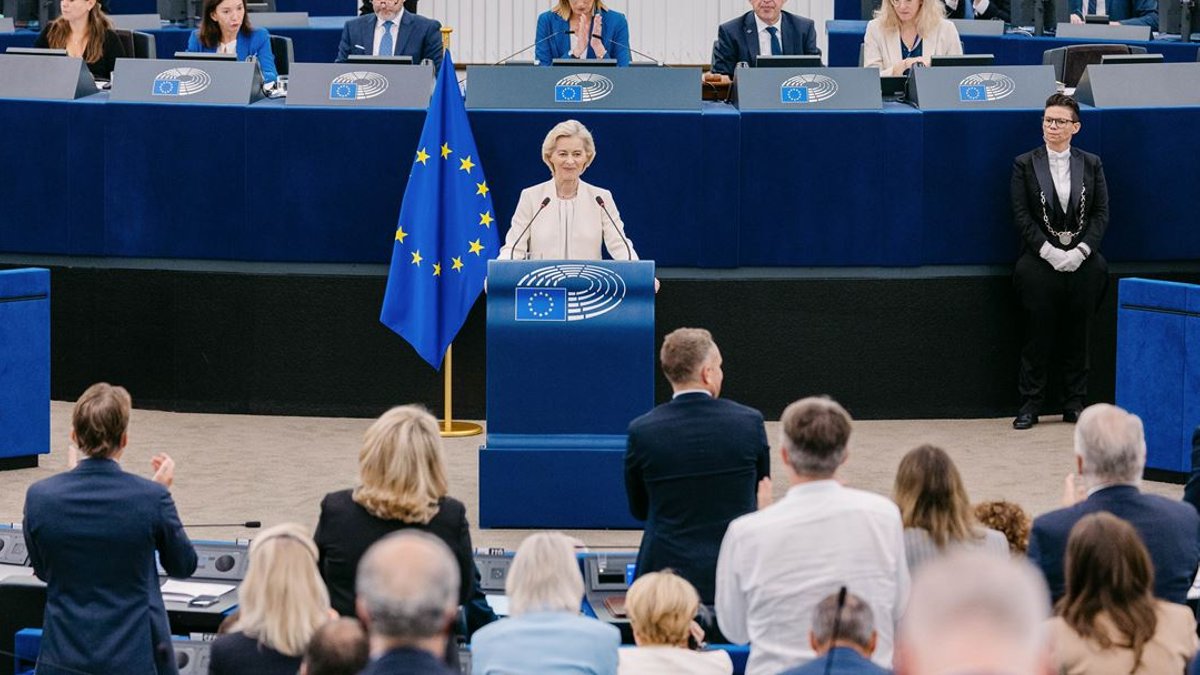
President Ursula von der Leyen began her 2026 State of the European Union address by stating the bloc was at its strongest yet also more exposed than in decades. Delivered in Strasbourg, her remarks combined bold initiatives with practical adjustments, addressing trade conflicts, unconventional warfare, and the growing intensity of technological and environmental threats.
The most pressing proposal involved tightening controls on children’s access to social media platforms. Under the EU Kids Act, services would be blocked for users under 13, while those aged 13 to 15 would be restricted to limited accounts. Older users over 15 would face daily time caps of one hour, shifting accountability for safety measures fully onto platform operators instead of parents.
Von der Leyen justified the restrictions by citing the accelerating pace of digital risks affecting young people. She said that the EU would take a gradual and differentiated approach, noting that “each age has its own sensitivities. And therefore, each will have its own tailored protection level.” The plan follows years of criticism over platforms’ inadequate safeguards but risks opposition from tech companies and parental advocacy groups pushing for voluntary standards.
EU-Canada Alliance Reshapes Trade and Security
Von der Leyen’s most significant diplomatic proposal redefined the EU’s relationship with Canada. She suggested upgrading the country from its current trade partnership under the Full Economic and Trade Agreement (CETA) to the bloc’s first associate member—a status between full membership and existing arrangements. The move highlighted “cultural, historical and personal links” between the two, while Mark Carney, Canada’s representative, adopted the EU Commission President after her remarks. The announcement marked a major turning point in the relationship, aligning with Carney’s middle powers strategy outlined in Davos earlier this year.
The upgraded partnership would focus on three key areas: securing supplies of critical minerals, advancing battery technology, and strengthening Arctic security. Von der Leyen proposed replacing CETA with an Alliance for the Future, a framework designed to support economic cooperation and political alignment. The announcement aligned with the EU’s broader effort to reduce dependence on China, where imports of essential raw materials remain critically high.
Security received less detail in the speech, though von der Leyen acknowledged the need for action. With Russia expanding hybrid warfare tactics, she proposed creating a European Security Council to coordinate responses alongside NATO allies, including the UK, Ukraine, and Norway. The plan included an Emergency Security Protocol to enable rapid, unified action when individual members faced threats short of full-scale conflict. This mechanism would operate independently of NATO’s Article 4 consultations, providing the EU with its own tools to counter hybrid threats.
Related Post: Dual Brexit bureaucracy strains Northern Ireland trade
Migration Pact Progress Amid Border Crisis Fallout
On migration, von der Leyen reported progress in implementing the Pact on Migration and Asylum, citing a 55% reduction in irregular crossings over two years. She introduced a European Emergency Response Framework to temporarily suspend standard procedures during crises, though she emphasized strict criteria would apply. The announcement followed tensions exposed by the Ceuta crisis, when nearly 80,000 migrants entered Spain from Morocco last summer, revealing divisions in the bloc’s asylum policies.
The speech presented a mixed approach to China. Von der Leyen warned that the EU’s daily trade deficit with Beijing—now exceeding €1 billion—represented a “second China shock,” but she avoided new sanctions or trade barriers. Instead, she announced plans for a European Corporation on Critical Raw Materials to cut reliance on Chinese imports, which supply over 80% of some rare earth elements. This reflected a strategic shift toward securing alternative sources rather than direct confrontation.
Discussions on Israel and Russia yielded few new developments. Von der Leyen acknowledged the failure to impose sanctions on Israeli settlers, a position she had supported the previous year, and instead called for stronger enforcement of existing measures. For Russia, she urged closing loopholes in sanctions, noting Moscow’s exploitation of weaknesses.
Climate Disasters Drive New Insurance and Heat Plans
Unlike previous addresses, this speech lacked major legislative announcements, suggesting a focus on managing existing challenges rather than expanding new initiatives. Climate adaptation emerged as a key priority, with von der Leyen framing this year’s wildfires and heatwaves as a preview of worsening environmental crises. She committed to launching a Climate Insurance Alliance to help governments cover rising disaster costs, which reached €3 billion from wildfires alone this year. Additionally, she unveiled plans for a European Heatwave Plan.
The address concluded with a diplomatic preview: a 2027 Congress of Europe to commemorate the 70th anniversary of the Treaty of Rome. Von der Leyen invited leaders and thinkers to participate, framing the event as an opportunity to renew public engagement with the EU’s institutions. The announcement carried symbolic weight but offered no concrete details on how the gathering would translate into policy outcomes, particularly as the bloc faced pressing demands in security, migration, and climate resilience.


