


Georgia Builds Truck Only Highway Lanes
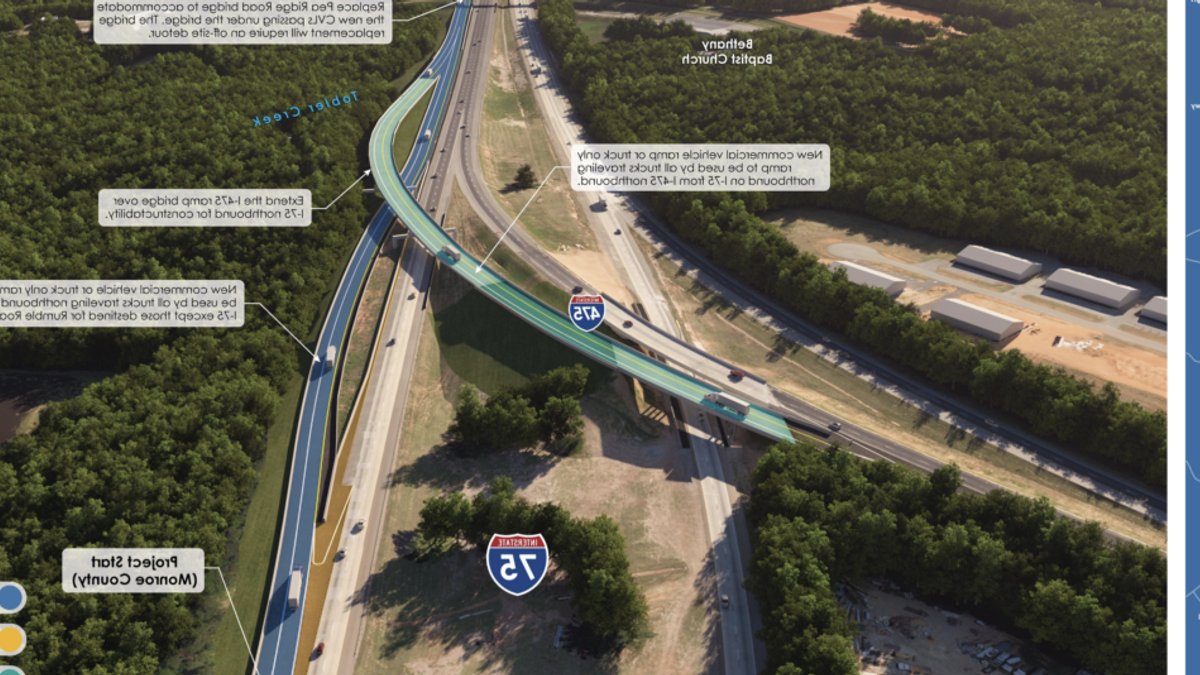
Georgia is moving ahead with a plan to build 41 miles of toll-free, truck-only lanes on I-75, a project that could become a model for other states. The Georgia Department of Transportation has released a construction timeline for the I-75 Commercial Vehicle Lanes project, with design work to be finalized and construction to begin in 2027, and completion expected by the end of 2032.
The project will add two new lanes along the northbound side of I-75, physically separated from the general purpose lanes by a barrier, and restricting them to commercial vehicles. The 41-mile corridor will run from the I-75/I-475 interchange in Monroe County to near the State Route 20 interchange in Henry County.
The core of the project is straightforward to describe and enormous to execute. The Georgia Department of Transportation is adding two new lanes along the northbound side of I-75, and restricting them to commercial vehicles. Under the current proposal, all trucks with more than six wheels must use the CVL unless they are destined for a local exit within the project limits.
The project carries GDOT project number 0014203 and an estimated cost in the range of $3.5 billion, with the state’s eminent domain filings estimating around 173 affected parcels of property and tens of millions of dollars in right-of-way acquisition.
The Georgia Department of Transportation did not pick this stretch at random. It picked one of the worst freight chokepoints in the United States. In the American Transportation Research Institute’s 2026 Top Truck Bottleneck List, I-75 at McDonough ranks as the tenth-worst truck bottleneck in the entire country.
Related: Professionals weigh in on value of CITP certification
Georgia as a whole placed nine locations on ATRI’s 2026 top 100 list, second only to Texas, and three Georgia bottlenecks landed in the national top ten. The McDonough chokepoint on I-75 is the one this project is built to fix.
The freight volume through the corridor explains why. GDOT officials have said truck traffic through this stretch of I-75 is approaching 30% of average daily traffic, an unusually high share, and the department expects it to keep climbing as economic development and port activity in Georgia grow.
The project went through a public comment process, and the response was mixed but leaned supportive. Of 132 comments GDOT received, 57 were in support, 35 offered conditional support, 19 were opposed, and 21 were uncommitted.
Two themes from the feedback are worth noting, because they speak directly to the people who will actually drive these lanes. First, commenters asked GDOT to include professional truck drivers in the planning process. Second, commenters raised concerns about traffic merging at the northern end of the CVL.
GDOT responded that coordination with transportation organizations will be important throughout the life of the project, and that its safety analysis shows the proposed merge area is expected to see fewer crashes than the current no-build scenario.
Related: MBA vs CITP Understanding the Key Differences
The commercial vehicle lanes are the main focus, but GDOT has paired the corridor work with truck parking investment, which is the quieter half of the freight-mobility problem. Alongside the CVL planning, GDOT has advanced a project to expand truck parking at Rest Area 22 along the corridor.
The project is budgeted at $2 million to add 36 truck parking spaces, with construction set to begin in summer 2027 and expected to take about 12 months. It is a modest number against the national parking shortage, but it reflects an understanding that moving trucks faster through a corridor and giving them somewhere legal to stop are two parts of the same problem.
For any owner-operator or small fleet that runs the Southeast, the I-75 corridor between Macon and Atlanta is familiar territory, and often a dreaded one. The practical promise of this project is real: a barrier-separated, toll-free lane through one of the ten worst truck bottlenecks in the country would directly return time and fuel to the drivers who run it.
There are reasons to keep expectations measured. Construction itself, running from 2027 to 2032, means years of work zones on an already difficult corridor before any relief arrives, and work zones are their own source of congestion and risk.
Georgia is spending roughly $3.5 billion to build 41 miles of toll-free, truck-only lanes through one of the ten worst freight bottlenecks in the country, a scale of dedicated-lane investment the United States has rarely attempted. If it works, it hands drivers back time and fuel on a corridor that currently crawls, and it becomes the proof of concept that decides whether other states build the same thing.

Lead times continue to rise sharply


